Sooner or later, almost every owner building in Grenada asks the same question: would it be cheaper to fill a container in Miami, Toronto or the UK and ship it down? Kitchen cabinets, tiles, sanitary ware, windows and appliances often look much cheaper online overseas than on the shelves of local suppliers.
Sometimes shipping really does save money. Often, by the time freight, insurance, customs duty, VAT, port and brokerage charges, inland haulage, breakages and the cost of waiting are added, the saving shrinks or disappears, and the owner has lost the local warranty and the easy replacement that buying on the island provides.
This decision guide explains how importing works for building materials, which items tend to be worth shipping and which are not, and the practical traps that catch owners who import for the first time. Duty rates, VAT and any concessions change, so confirm the current position with the Customs and Excise Division or a licensed customs broker before you buy.
What local suppliers do well
Grenada has established hardware and building suppliers, with the larger ones concentrated around St George's and Grand Anse and smaller outlets in the main towns such as Grenville and Gouyave. They carry the core materials of local construction: cement, blocks, steel reinforcement, timber, roofing sheets, fixings, plumbing and electrical basics, paint and a range of finishes. Concrete is supplied ready-mixed or mixed on site, and aggregates are sourced locally or imported.
Buying locally has advantages that do not show up on a price comparison. You can see and handle products, buy exactly the quantity needed, return or exchange items, open a builder's account, and replace a broken tile or a faulty pump within days. Suppliers also understand what holds up in local conditions and what the island's builders are used to installing.
The limitations are range and price. Choice of finishes, high-end fittings and specialist products is narrower than in a large mainland market, and imported goods on local shelves already carry freight, duty, VAT and the retailer's margin. For bulk structural materials, though, buying locally is almost always the practical choice.
Items that are often worth importing
Windows, doors and hurricane shutters. Specialised impact-rated or high-performance products are sometimes cheaper or only available abroad. Make sure they are rated for the wind loads your engineer specifies and that a local installer is willing to fit them.
Kitchen cabinetry. Flat-pack or custom kitchens can offer value, though humidity-resistant materials matter; particleboard carcasses can swell in a damp climate.
Sanitary ware and tiles. A wider range is available abroad, but tiles are heavy and breakable. Order spares, typically ten per cent or more, because matching a batch later is difficult.
Lighting, fans and specialist electrical items. Compatible with local supply standards only if chosen carefully. Grenada uses 230-volt supply at 50 hertz, unlike North America, so check every electrical item before buying.
Solar equipment. Panels, inverters and batteries are sometimes imported directly. Check whether any special tax treatment applies at the time and whether local installers will warranty an installation using equipment they did not supply.
How importing works in practice
A typical shipment of building materials and fittings follows these steps:
- Make a complete list of items with quantities, values and specifications, matched against your drawings.
- Get freight quotes from shipping lines or consolidators serving Grenada, either for a full container or for space in a shared one.
- Prepare a detailed packing list and commercial invoices; vague descriptions such as "household goods" cause delays and disputes at customs.
- Insure the goods for the sea passage and handling.
- Appoint a licensed customs broker in Grenada to lodge the declaration, calculate duty, VAT and other charges, and arrange clearance at the port in St George's.
- Pay duty, VAT, port charges and brokerage fees before the goods are released.
- Arrange haulage to the site and labour to unload, and check every item against the packing list immediately for damage.
- Store goods securely until they are installed.
Adding up the real cost
The sticker price abroad is only the start. On top come freight, marine insurance, port charges, customs duty, VAT, brokerage, local haulage and handling. Duty rates vary by product under the regional common external tariff, and VAT is charged on top of the duty-inclusive value, so the combined effect on some categories is large. A broker can estimate duties item by item before you commit, and that estimate is worth paying for.
Then add the hidden costs. Damaged or missing items mean reordering from abroad and waiting weeks. A container that arrives before the house is ready needs secure storage; one that arrives late leaves the builder idle. Mistakes, such as the wrong size of window or an appliance with the wrong voltage, are expensive to correct.
Owners who save money by importing usually do so on a focused list of high-value, specific items, rather than by trying to ship an entire house. Compare the landed cost of each item with a written local quote before deciding.
Pitfalls first-time importers meet
Warranties that do not travel. Manufacturers' warranties on goods bought abroad often require the item to be returned to the country of purchase. In practice, a faulty imported pump or appliance may be repaired at your own cost.
Products unsuited to the climate. Indoor-rated fixings, mild steel hardware, untreated timber and furniture-grade cabinetry deteriorate quickly in salt air and humidity. Specify marine-grade or tropical-rated products.
Wind ratings that do not match. Windows and doors marketed as hurricane-proof must still meet the design pressures your engineer sets for your site and exposure. Ask for test certificates.
Installers unfamiliar with the product. An unusual system can be fitted badly by a crew that has never seen it, voiding any warranty. Confirm installation support before ordering.
Concessions assumed, not confirmed. Grenada has offered concessions to returning nationals and certain approved projects, but conditions are specific and change. Confirm eligibility in writing before shipping.
Timing deliveries and storing goods on site
Timing is where imported goods most often cost money. Windows, doors and shutters are needed when the walls and ring beam are complete and openings are formed to their final sizes; kitchens, sanitary ware and tiles are needed only once plastering and first-fix services are finished. A single container carrying everything forces you either to store some items for many months or to wait for the slowest item before shipping.
Many owners ship in two lots: openings and structural fittings first, finishes later. The second shipment can then be adjusted to the decisions made on site, such as a change in kitchen layout. It costs more in freight, but it reduces storage, damage and the risk of buying the wrong thing.
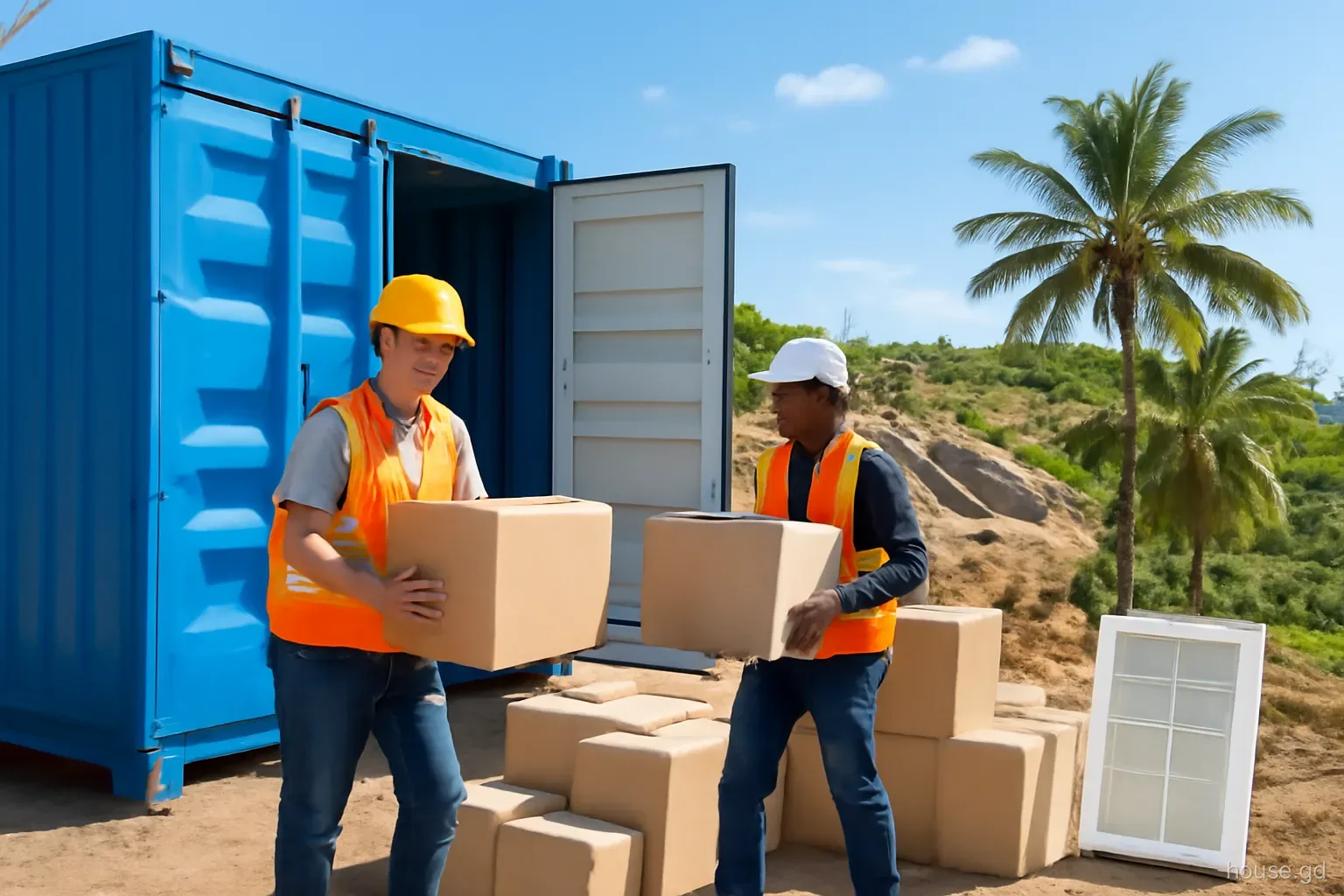
Wherever goods wait, they need a dry, lockable, ventilated store. Cardboard packaging soaks up moisture in the rainy season, cabinet boards swell, and boxed fittings attract theft. Some owners keep the container on site as a store for the duration of the build; check whether the access road and plot can take it and whether hire or demurrage charges apply.
Making the decision item by item
The most reliable way to decide is a simple spreadsheet. For each item, list the overseas price, an estimated share of freight and insurance, the broker's estimate of duty and VAT, and handling to site. Beside it, put a written local quote for the same or an equivalent product, delivered. Add a column for risk: how hard would it be to replace if it arrived broken or wrong?
Items with a large saving and low replacement risk, such as a specific range of windows ordered with the correct dimensions from approved drawings, are good candidates for importing. Items with small savings, high breakage rates or heavy weight, such as standard tiles or basic sanitary ware, often are not.
Talk to your builder before deciding. Crews are used to the products sold locally, and a builder who has to source fixings for an unfamiliar imported system may charge more for labour, which belongs in the comparison too.
Frequently asked questions
Is it cheaper to ship building materials to Grenada than to buy locally?
For some high-value, specific items such as windows, kitchens or fittings, importing can save money. For bulk materials like cement, blocks and steel, local purchase is almost always more practical. Compare the full landed cost, including duty, VAT, freight and brokerage, against written local quotes item by item.
Do you need a customs broker to import building materials?
Using a licensed customs broker is strongly advisable and is the normal route for commercial shipments. The broker lodges the declaration, classifies items, calculates duty and VAT and arranges clearance. Their fee is usually small compared with the cost of delays or misclassification.
What electrical standard does Grenada use?
Grenada's supply is 230 volts at 50 hertz, and British-style three-pin sockets are common. Many North American appliances and fittings designed for 120 volts at 60 hertz will not work properly without conversion. Check every electrical item, including fans, lighting and pumps, before buying abroad.
Are building materials duty-free for returning nationals?
Concessions for returning nationals have historically focused on personal and household effects and a vehicle, under conditions. Whether any relief applies to building materials depends on current rules. Ask the Customs and Excise Division or a broker, and get confirmation in writing before shipping.
How long does a container take to clear in Grenada?
Clearance time depends on paperwork, inspection and how quickly duties are paid. A complete, accurate packing list and invoices, lodged through a broker, keep things moving. Allow time in your building schedule for clearance and haulage rather than planning installation the day the ship docks.
Should tiles and fittings be ordered with spares?
Yes. Order extra tiles, often ten per cent or more, plus spare fittings for items that break easily, because matching a batch later is difficult and reordering from abroad takes weeks. Store the spares in a dry place for future repairs.