For many Grenadian households the generator is the quiet partner of hurricane season. Day to day, the GRENLEC grid on the mainland is reasonably dependable, but planned maintenance, a fallen line in heavy rain or a major storm can leave a house without power for hours, days or, after a hurricane like Ivan in 2004, weeks. Those who remember Ivan, and people on Carriacou and Petite Martinique after Beryl in 2024, rarely need persuading of the value of backup power.
Buying well is about three choices: how much power you really need, which fuel suits your location and habits, and how the generator connects to the house safely. Getting the last one wrong is not just a technical fault. A generator plugged into a house without proper isolation can send power back down the lines and endanger the crews trying to restore supply. This article covers all three, along with the practical details of running a generator through a long outage.
Sizing: what do you need running?
Start with a list of what must work during an outage, and add up running watts. A refrigerator might draw a few hundred watts while running, a chest freezer less, LED lights and ceiling fans very little, the Wi-Fi router almost nothing. A cistern pump is a modest load but starts with a surge. Window or split air-conditioners are the big decision: a single efficient bedroom unit may run on one to one and a half kilowatts, but several units quickly push the total beyond a portable machine.
Motors need a burst of extra power to start. Pumps, older refrigerators and non-inverter air-conditioners can draw two to three times their running load for a second or two. A generator sized only on running watts will stall or trip every time the pump kicks in. Sizing for the largest starting load plus everything else running gives the realistic figure.
As a rough guide, a portable generator of 3 to 5 kW covers fridge, freezer, lights, fans, pump and electronics. Adding one air-conditioner usually moves you to 5 to 8 kW. Whole-house backup with several units and an electric water heater can mean 15 kW or more. Water heaters, kettles, irons and electric stoves are best kept off the generator altogether; they burn fuel for little benefit.
Choosing the fuel
Petrol (gasoline). The common fuel for portable and inverter generators. It is easy to buy, but it degrades in storage within months, especially in heat, and storing more than a small quantity safely at home is difficult. Fine for occasional short outages.
Diesel. Standby generators for larger homes and guesthouses usually run on diesel. It stores better than petrol, the engines are durable, and fuel use under load is efficient. Diesel units are heavier, noisier unless enclosed, and cost more upfront. Stored diesel still needs to be kept clean and dry.
LPG (cooking gas). Many Grenadian kitchens already run on LPG cylinders. Dual-fuel or LPG generators burn cleanly, and the fuel keeps indefinitely in sealed cylinders. Output on gas is somewhat lower than on petrol, and a long outage needs several large cylinders, so check availability and storage.
After a hurricane, fuel is the bottleneck. Following a major storm, fuel stations may be shut, damaged or rationed and roads blocked. Whatever fuel you choose, keep a safe reserve in approved containers, rotate it, and know roughly how many hours each container gives you.
Solar as a fuel saver. Homes with a hybrid solar system and batteries can run the generator briefly each day to top up the bank rather than continuously, cutting fuel use dramatically during long outages.
Connecting safely: transfer switches and isolation
The single most important rule is that a generator must never be connected to house wiring in a way that can feed back into the grid. Plugging a generator into a wall socket with a double-ended lead, sometimes called a suicide cord, energises the house wiring and, through the meter, the street lines. Line workers repairing what they believe is a dead line can be electrocuted, and the generator itself can be destroyed when grid power returns.
The proper solution is a transfer switch, installed by a licensed electrician. A manual transfer switch lets you move selected circuits, or the whole house, from grid to generator with a lever, physically separating the two sources. An automatic transfer switch, usually paired with a standby generator, senses the outage, starts the generator and switches over within seconds, then switches back when grid power is restored. Interlock kits on the main panel achieve similar isolation at lower cost where permitted.
For a portable generator, the safe alternative to a transfer switch is to run heavy-duty extension leads directly to individual appliances. It is clumsy but safe, and many households use it for short outages.
What a generator really costs to run
A generator is an expensive way to make electricity, and it helps to know how expensive before an outage stretches into its second week. Fuel consumption depends on the engine and the load, but as a rough illustration, a portable petrol unit of around 5 kW running at half load might burn somewhere in the region of one and a half to two and a half litres an hour, and a diesel standby unit of 10 to 15 kW somewhat more. Over ten hours a day, that becomes a significant fuel bill at Grenada pump prices.
Divide fuel cost by the kilowatt-hours produced and the cost per unit of generator power usually comes out well above the GRENLEC tariff, especially at light loads, where engines are least efficient. That is the logic behind running the generator in blocks, for example a few hours in the morning and evening to cool the fridge and freezer, pump water and charge devices, rather than all day for a single fan.
Add servicing, oil changes, replacement parts and the eventual replacement of the machine, and it becomes clear why many households who face frequent outages eventually invest in batteries and solar, keeping a smaller generator only as a reserve for long cloudy spells after a storm.
Placement, noise and carbon monoxide
Where the generator sits matters for safety, for the machine's life and for relations with the neighbours.
- Never run a generator indoors, in a closed garage, or under a window or door. Exhaust contains carbon monoxide, which is invisible and odourless and can kill. A battery-powered carbon monoxide alarm inside the house is a cheap safeguard.
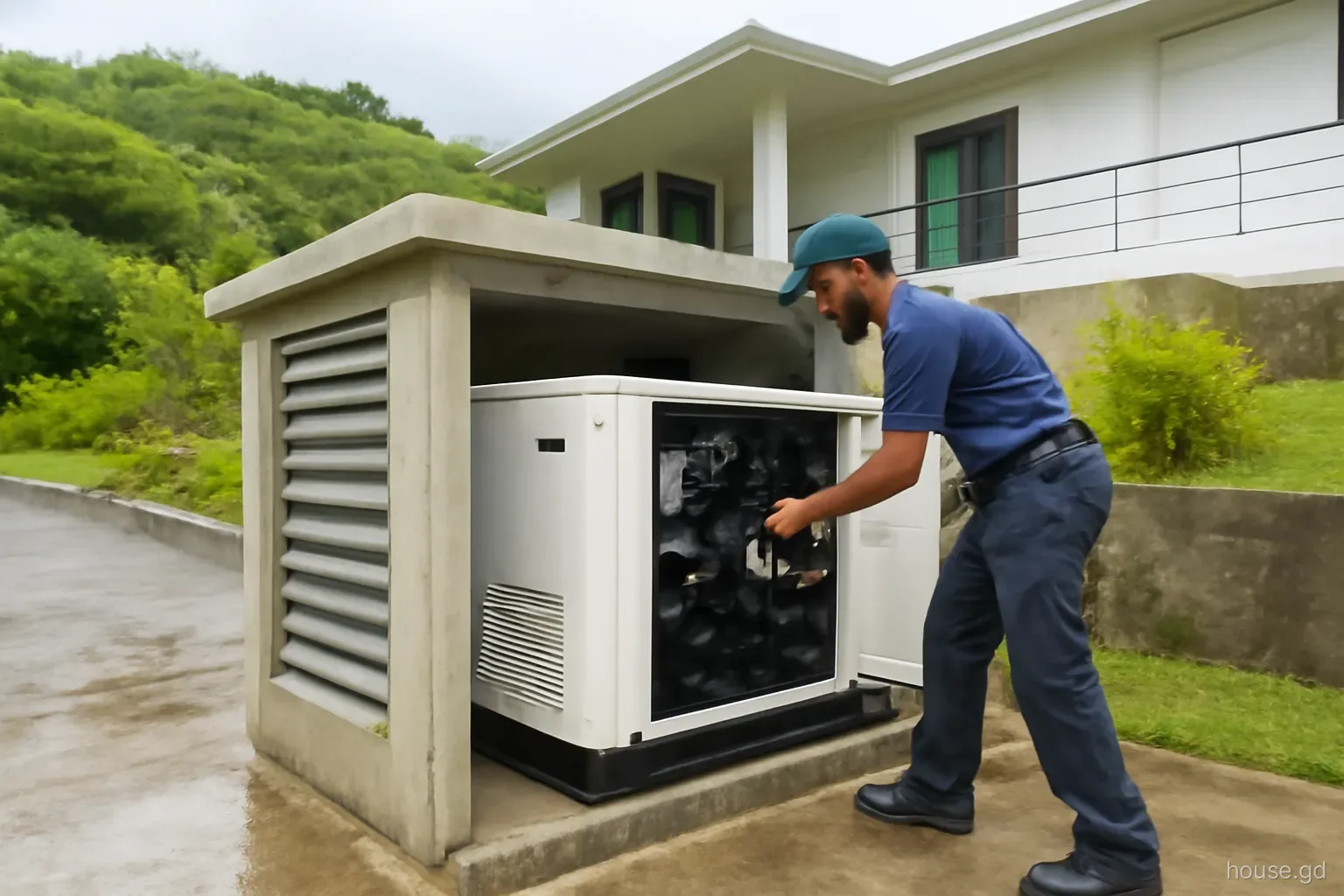
- Shelter without enclosing. A roofed, open-sided shelter or a purpose-built ventilated enclosure keeps rain and sun off while letting exhaust and heat escape.
- Salt and humidity. Close to the sea, corrosion attacks terminals, panels and frames. A cover when not in use, and a regular wipe with corrosion inhibitor, add years.
- Noise. In closely built areas such as Grand Anse, Belmont or around St George's, an open-frame generator running all night will be heard by everyone nearby. Inverter generators and enclosed standby units are much quieter.
- Security. Portable generators are easy to carry away. A chain or lockable enclosure helps, particularly after storms when theft can rise.
- Flooding. Place standby units on a raised base above any area that collects water in heavy rain.
Keeping it ready through hurricane season
A generator that has not run since last year often fails at the moment it is needed. A simple routine prevents that.
- Start and run the generator under some load for 20 to 30 minutes every month, ideally all year and certainly from June to November.
- Have it serviced before the season: oil and filter changes, spark plugs on petrol units, fuel filters on diesel, battery check on electric-start models.
- Stabilise stored petrol or rotate it every few months, and keep diesel containers sealed and dry to avoid water and microbial growth.
- Check that leads, plugs and the transfer switch are in good condition and that everyone in the house knows the shutdown and changeover steps.
- When a storm warning is issued, top up fuel, test-run the unit, secure it against wind and flooding, and do not run it during the storm itself.
- After the storm, inspect for water ingress and debris before starting, and keep running time to what is needed to make fuel last.
Frequently asked questions
What size generator does an average Grenada house need?
For essentials such as fridge, freezer, lights, fans, water pump and electronics, 3 to 5 kW is usually enough. Running one air-conditioner as well typically needs 5 to 8 kW, and whole-house backup with several units needs considerably more.
Is a transfer switch required by law in Grenada?
Any connection of a generator to house wiring should be done by a licensed electrician in a way that prevents feeding power back into the grid, which in practice means a transfer switch or approved interlock. Check current requirements with GRENLEC or a licensed electrician.
Diesel or petrol: which is better for a home generator?
Petrol suits small portable and inverter units used occasionally. Diesel suits larger standby generators that may run for long periods, as it stores better and engines are durable. LPG is a clean, storable option for households already using cooking gas.
How much fuel should be stored for a hurricane?
Work out how many litres your generator burns per hour at typical load and plan for several days of limited running, perhaps six to ten hours a day. Store fuel only in approved containers, away from the house and any ignition source.
Can a generator run my central air-conditioning?
Possibly, but it takes a large generator, and the starting surge of older units is high. Most households back up one efficient bedroom unit and use fans elsewhere, which needs a far smaller and cheaper generator and much less fuel.
Why is backfeeding dangerous?
Power fed from a house generator through the meter can travel into the grid and be stepped up by transformers, putting line crews at risk of electrocution. It can also damage the generator and the house wiring when grid power is restored.