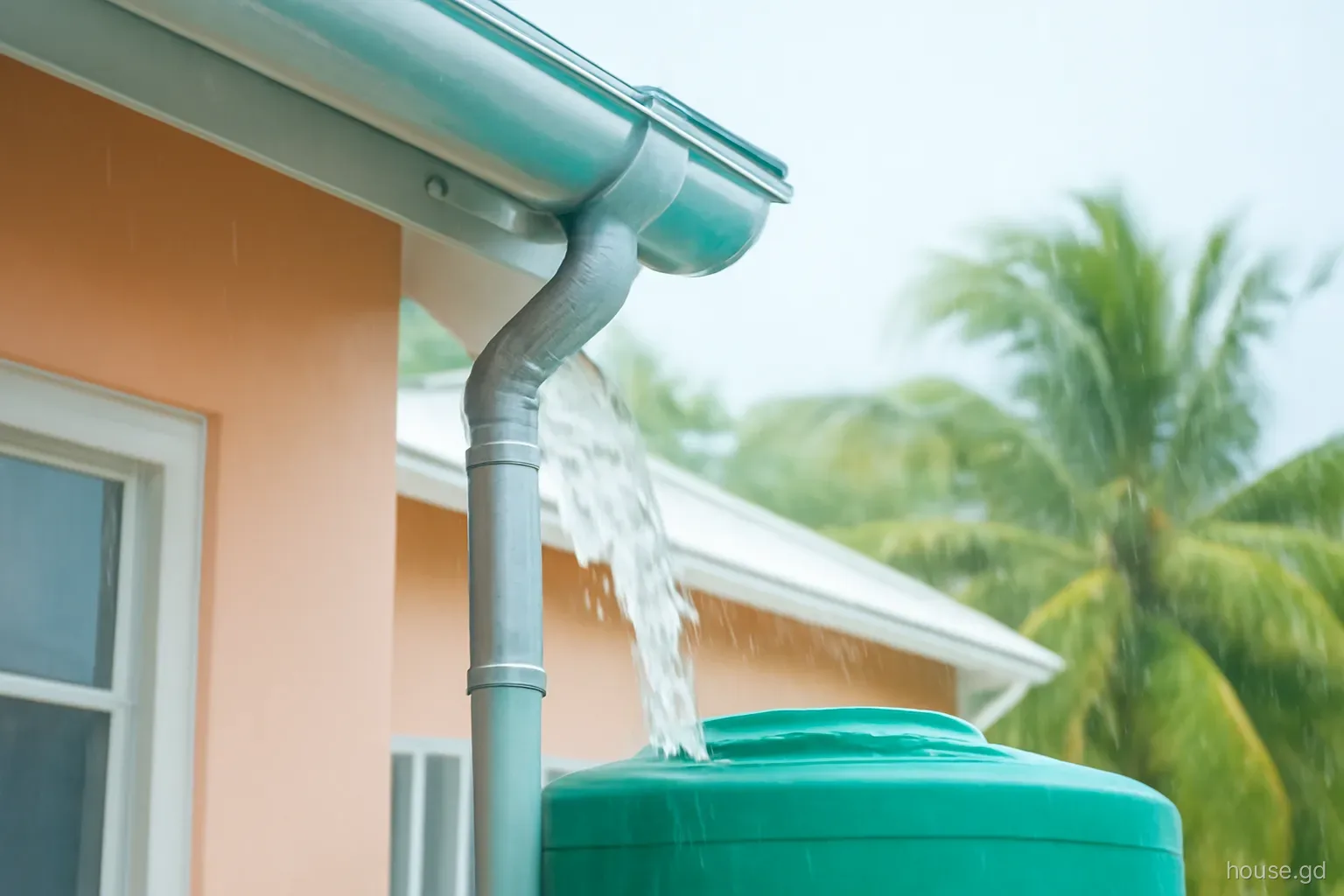

Older Grenadian houses were often built over a concrete cistern, and anyone who has lived through a March or April with the taps running dry understands why. The public supply from the National Water and Sewerage Authority (NAWASA) comes largely from rivers and streams in the interior, and in the dry season, roughly January to May, flows drop and some areas get scheduled supply. On Carriacou and Petite Martinique, with no rivers to speak of, stored rainwater and desalinated water have always been the basis of household supply.
Getting the size right is one of the cheapest decisions to make at the design stage and one of the most expensive to correct later. Too small, and you are buying truck deliveries every dry season. Too large, and you have poured concrete and money into water that never gets used, sometimes going stale. The method below balances three things: how much you use, how much your roof can collect and how long you need to bridge.
Start with what the household actually uses
Demand is the anchor. A careful household in Grenada might use somewhere around 100 to 150 litres per person per day for showers, toilets, cooking, dishes and laundry. Households with washing machines running daily, long showers, garden watering or frequent guests can use far more, 200 litres per person or above. A villa with a pool and a lawn is a different category altogether.
If the house already has a NAWASA meter, the bills give real figures. Otherwise estimate from the fixtures. A modern dual-flush toilet uses around 4 to 6 litres a flush against 9 or more for an older cistern-flush model; a shower runs at perhaps 8 to 12 litres a minute; a front-loading washing machine uses a fraction of a top-loader. Swapping fixtures is often cheaper than adding storage.
Multiply the daily figure by the number of people, then by the number of days you want to cover. A family of four at 130 litres per person uses about 520 litres a day, or roughly 15,600 litres a month. Over a 90-day dry-season gap that is about 47,000 litres; over 120 days it is more than 62,000.
Then work out what the roof can collect
The basic formula. One millimetre of rain falling on one square metre of roof yields one litre of water. Multiply the roof's plan area (its footprint, not the sloped surface) by the rainfall in millimetres, then by a collection factor of about 0.75 to 0.85 to allow for evaporation, splash and first-flush losses.
Rainfall varies enormously across the islands. The south-west around Point Salines and the south coast is among the driest parts of the mainland, while the mountainous interior around Grand Etang receives several times more. Carriacou and Petite Martinique are drier again. Use rainfall data for your area, from the meteorological service or from long-time neighbours, rather than a national average.
A worked example. A 150-square-metre roof in a south-coast location receiving, say, 1,300 mm a year, with a factor of 0.8, collects about 156,000 litres annually. That comfortably exceeds the family's yearly demand on paper, but the rain does not arrive evenly.
Seasonality is the real constraint. Most rain falls between about June and December. In the dry months, collection can drop to a trickle. Your cistern has to carry you from the last good rains through to the return of the wet season.
Not all roofs are suitable. Galvanised sheeting and coated metal roofs collect clean water well. Roofs with lead flashing, old paint that may contain lead, or heavy tree cover need attention before the water is used in the house.
Choosing a target size
With demand and catchment estimated, choose the role the cistern plays. These are typical starting points to test against your own numbers.
- Backup to a reliable mains supply: on the mainland in an area with steady NAWASA supply, storage for one to three weeks of use (roughly 5,000 to 15,000 litres for a family) covers rationing and repairs.
- Main supply with mains as backup: in drier areas or where the mains is unreliable, aim to bridge two to three dry months, often 30,000 to 50,000 litres or more for a family.
- Rainwater only: for Carriacou, Petite Martinique or an off-grid plot, size for the full dry season plus a margin, and plan for occasional truck or desalinated top-ups in a very dry year.
- Pools and gardens: calculate separately. A pool loses a surprising amount to evaporation in the dry season, and irrigating a lawn from a cistern drains it fast.
- Holiday rentals: guests use more water than residents, and a dry tap during a booking costs reviews. Err on the larger side.
Concrete under the house, or tanks above ground?
The traditional reinforced-concrete cistern under the house or a terrace has real advantages: it keeps water cool and dark, which limits algae; it adds no visible clutter; and its slab can carry a floor above. Built at the same time as the foundations, the extra cost per litre is reasonable. It must be designed by someone who understands water-retaining concrete, with proper waterproofing, a sealed access hatch, an overflow and a way to drain and clean it.
Above-ground polyethylene tanks are the common alternative and the usual retrofit. They are quick to install, easy to add to and cheap per litre. They should be opaque, sited on a level, solid base, kept out of full sun where possible and strapped or anchored, because an empty tank is light enough to fly in hurricane winds. Placing tanks higher up the slope than the house can give gravity pressure without a pump.
When comparing quotes, note that tank capacities are often sold in gallons. Check whether a supplier means imperial gallons (about 4.55 litres) or US gallons (about 3.79 litres); the difference is roughly twenty per cent, which matters when you are sizing for a dry season.
Sizing mistakes worth avoiding
These come up again and again when owners review a house that never seems to have enough water.
- Sizing from annual rainfall alone and ignoring the dry-season gap.
- Forgetting that guests, a pool or a washing machine can double daily demand.
- Building a large cistern with only a small part of the roof guttered into it.
- Leaving no overflow route, so heavy rain backs up into gutters or undermines foundations.
- Installing a single cistern with no way to isolate and clean it without losing all storage. Two compartments, or a cistern plus a tank, give flexibility.
- Leaving openings unscreened, which invites mosquitoes; Aedes mosquitoes, which spread dengue, breed readily in standing water.
- Not checking whether the cistern can also be filled from the mains or by truck when rainfall fails.
Carriacou and Petite Martinique: sizing for drier islands
On the sister isles the calculation changes character. There are no permanent rivers feeding a public network in the way the mainland's interior does, so households have always depended on roof catchment and storage, supplemented by desalinated water produced by NAWASA and by truck deliveries in hard years. Rainfall is lower and the dry season bites harder, which pushes the storage needed per person well above a typical mainland figure.
Here the cistern is not a backup; it is the supply. Owners commonly aim to carry the household through the whole dry season, and they gutter every part of the roof, including outbuildings and verandas, into storage. Water-saving fixtures and grey-water reuse for gardens are worth more on Carriacou than almost anywhere on the mainland.
Hurricane Beryl in July 2024 damaged many roofs, gutters and tanks on both islands. Anyone buying or rebuilding there should check that the catchment has been fully restored, that tanks are anchored and that the cistern itself was inspected for cracks after the storm. Supply arrangements and delivery options may also have changed since then, so check the current position locally before relying on them.
Frequently asked questions
What size cistern is normal for a house in Grenada?
There is no single standard. Houses that rely mainly on NAWASA often have 5,000 to 15,000 litres of backup, while homes depending on rainwater, especially on Carriacou, may store several times that. Base the size on household demand and the length of the dry season where you live.
Is cistern water safe to drink?
Rainwater from a clean roof can be good quality, but it should be filtered and disinfected before drinking, for example with sediment filtration plus chlorination or UV treatment. Many households use cistern water for washing and toilets and filtered or bottled water for drinking.
Can a cistern be filled from the mains?
Many houses do, using a float valve so the mains tops up storage when supply is available. Check that the arrangement prevents backflow into the public system and confirm any NAWASA requirements before connecting.
How much rain does Grenada get?
It varies widely. The dry south-west of the mainland receives far less than the interior rainforest around Grand Etang, and Carriacou is drier still. For sizing, use local figures for your area rather than an island-wide average.
Does building a cistern need planning approval?
A cistern built as part of a new house is included in the building plans submitted for approval. Large retrofits involving excavation or structural work near foundations should be checked with the planning authority and an engineer before work starts.
How often should a cistern be cleaned?
Many owners drain and clean a cistern every one to three years, depending on how clean the roof and gutters are and whether a first-flush diverter is fitted. Sediment build-up, odour or discoloured water are signs it is due.