
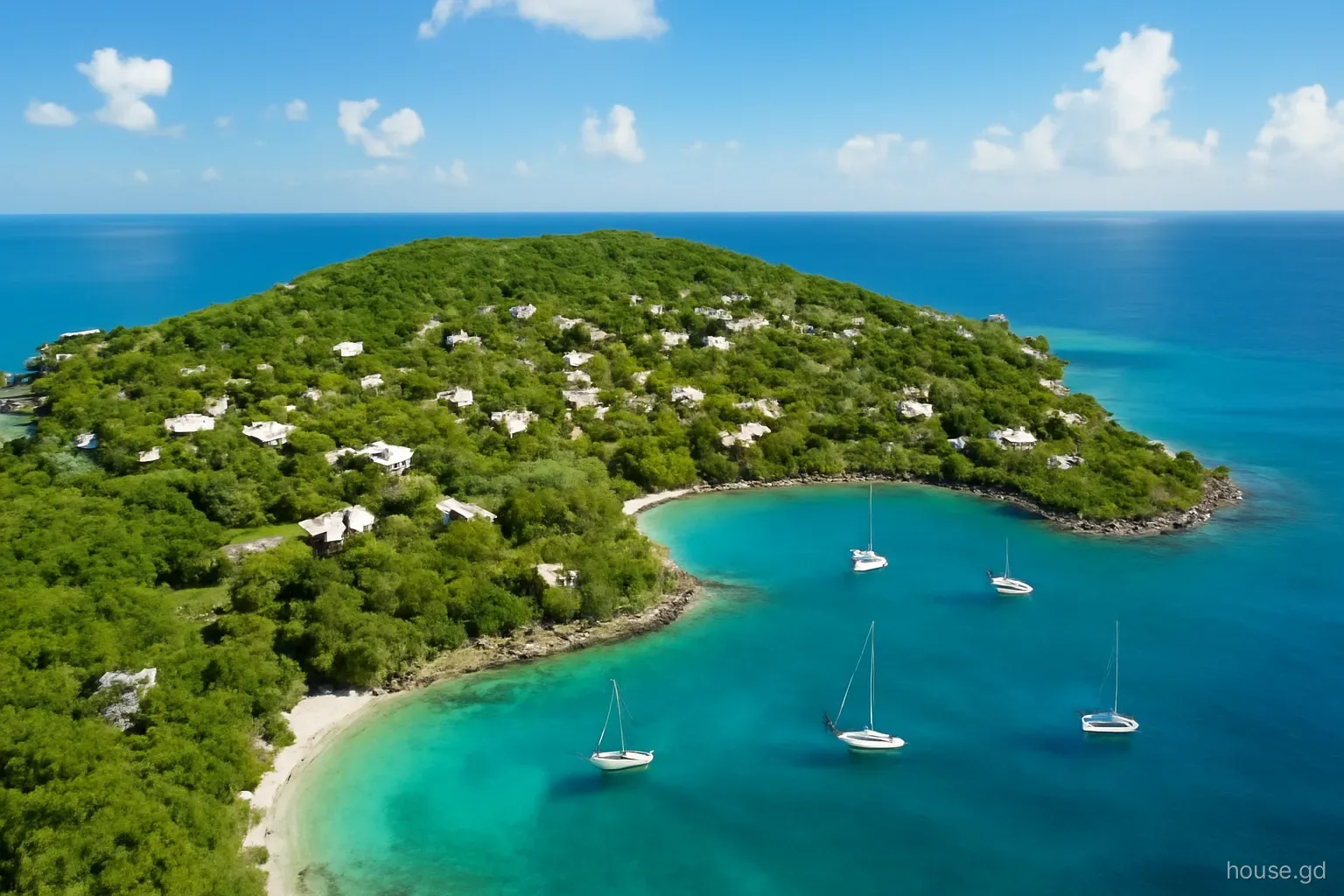
East of Lance aux Epines, Grenada's south coast stops being a straight line. It breaks into a run of fingers and inlets: Egmont and the Calivigny shore, Woburn and Clarke's Court Bay, Fort Jeudy, and further east Westerhall Point in St David's. Each headland has its own character, and several are organised developments with covenants, security staff and an owners' association.
From the air they look alike: green slopes, white roofs, sheltered water. On the ground the differences are significant. Some are built-out communities with paved roads and rules on everything from roof colour to rentals; others are a patchwork of private lots along rough lanes. This comparison sets out what distinguishes them, who tends to live where, and what to ask before choosing one.
Westerhall Point
What it is. A long-established planned residential development on a peninsula in St David's, with its own entrance, internal roads and a residents' association. Plots are generous and many homes have sea views on two sides.
Who lives there. Largely retirees and second-home owners from North America and Europe, along with Grenadian professionals. It has a reputation as one of the quieter and more orderly places to live on the island.
Rules and fees. Expect covenants on building design, setbacks and use, plus an annual charge for road maintenance, common areas and security. Ask for the current covenants and recent accounts rather than relying on what an agent remembers.
Trade-offs. It is a drive from the supermarkets of Grand Anse, typically twenty to thirty minutes depending on traffic, and the nearest village shops are basic. You live here for calm, views and neighbours who value the same, not for convenience.
Nearby. The Westerhall estate, known for its rum, gives the area its name, and La Sagesse with its beach and mangroves is a short drive east.
Fort Jeudy and Egmont
Fort Jeudy sits on a headland in St George's parish, between the inlets east of Lance aux Epines. It is a residential estate with larger homes, many positioned for views over the bays towards Calivigny Island and Hog Island. The access road is narrow in places, and the community is small enough that residents tend to know who belongs and who does not, which many find reassuring.
Egmont, on the shore facing Calivigny, has seen more recent development, including marina-side and waterfront projects aimed at buyers with boats. Some of these have been marketed to citizenship by investment buyers, which affects resale: a unit bought under that programme often carries conditions on how soon it can be resold to another applicant, and the price may reflect the programme rather than the open market.
Both areas share the same practical profile as the rest of the south-east: car-dependent, quieter than Grand Anse, and closer to the airport than Westerhall. They suit people who want to be near the water and the main services without the density of the beach strip.
Woburn, Clarke's Court Bay and Calivigny: a more local mix
Woburn is a long-established Grenadian village above Woburn Bay, and the surrounding shoreline around Clarke's Court Bay is home to a marina and a sizeable community of liveaboard sailors. Here the housing is a mix of village homes, small apartment buildings and occasional larger houses on the slopes. It is less polished than the planned estates, and for many people that is the attraction.
Prices for land and rentals in these villages are generally below those in the gated developments, and life feels more connected to Grenada beyond the expatriate circuit. There are rum shops, fishing boats and Sunday cricket. Hog Island, a short boat ride away, has long been a weekend gathering spot for the sailing crowd.
The caveats are the usual ones for village living: roads may be steep and potholed, building standards vary from house to house, and boundaries and title can be less straightforward than on a planned estate with surveyed lots. Careful legal checks matter more here, not less.
For boat owners: what the bays offer and do not
The south-east is the part of Grenada where owning a boat feels natural, and many buyers choose a peninsula for that reason. A few realities to factor in:
- Several bays are well sheltered and used as hurricane holes by visiting yachts, which brings activity but also crowding in the season from June to November.
- A private jetty depends on permission for the structure on the foreshore. Do not assume an existing jetty is legal or transferable; ask your attorney to check.
- Marinas and boatyards in Clarke's Court Bay, Woburn, Egmont and nearby Petite Calivigny provide moorings and services, but availability and pricing change, so confirm before counting on a berth.
- Shallow water and seagrass near the shore can limit where you can moor a larger vessel close to the house.
- Mangrove areas along these coasts are protected, and clearing or dredging them requires approval that is rarely granted.
Water, roads and services on the peninsulas
Water supply. Mains water reaches most of the south-east, but pressure falls on higher ground and at the ends of long pipes. Cisterns and pumps are standard, and in a dry year some owners buy water by truck. Ask how often the house has run short.
Roads. Internal roads in planned estates are usually maintained by the association; public roads into villages are maintained by government, sometimes slowly. A paved road today does not guarantee a paved road in three rainy seasons.
Power cuts. Outages after storms can last longer on the peninsulas than in the central south, because lines run through exposed, wooded terrain. Generators and solar systems are common for that reason.
Rubbish and post. Check where household waste is collected and whether postal delivery reaches the house or you will use a box. These small details shape daily life more than the view does.
Living here year-round or part of the year
Many homes on the south-east peninsulas are occupied for only part of the year, typically from December to April when owners escape northern winters. That pattern shapes the neighbourhood. In the summer months some lanes are almost empty, which is peaceful but also means fewer eyes on empty houses and fewer neighbours to call on when a tree comes down across the road.
Part-time owners depend heavily on a caretaker or property manager who checks the house after heavy rain, runs the taps and air-conditioning, clears gutters and cistern inlets, and prepares shutters when a storm threatens. Budget for this as a fixed cost, and agree in writing what the visits include and how often they happen.
Year-round residents, by contrast, become the backbone of the owners' associations and the informal networks that share tradespeople, water deliveries and storm preparations. If you plan to live here full-time, ask how many neighbours do the same; a street where you are the only permanent household feels very different in September than it does in February.
Choosing between them: a short decision sequence
Narrowing the choice is easier if you answer these in order:
- Decide whether you want an organised estate with rules and fees, or a village setting with fewer rules and more variability.
- Drive the route from each area to Grand Anse and the airport at 7.30 am and 4.30 pm on a weekday, not on a Sunday afternoon.
- Read the covenants of any estate, especially clauses on rentals, extensions, pets and boats, and get the last three years of fees.
- Talk to residents. Owners' associations can be harmonious or fractious, and only people who live there will tell you which.
- Check storm exposure: south-facing points take swells, low shores near mangroves can flood, steep lots need sound retaining walls.
- Rent in your preferred area for at least a few weeks, ideally in the rainy season, before committing to a purchase.
Frequently asked questions
Is Westerhall Point gated?
Westerhall Point is a planned development with a controlled entrance and its own internal roads, and it has a residents' association that manages common matters. Access arrangements and security staffing can change, so ask the association what currently applies.
How long is the drive from Westerhall to Grand Anse?
Typically twenty to thirty minutes, depending on traffic on the main road through the south of the island. At school times and in the late afternoon it can take longer, so test the drive at the hours you would actually travel.
Are estate fees in these developments high?
They vary by development and by what they cover, such as security, roads, street lighting and landscaping. Ask for several years of accounts and any planned special levies, because a road resurfacing project can add a large one-off bill.
Can you rent out a house on a gated peninsula?
Often yes, but some covenants restrict short-term holiday letting or require approval from the association. Read the covenants before buying if rental income is part of your plan, and confirm any tourism licensing requirements.
Which south-east area is best for living among Grenadians?
Villages such as Woburn and the areas inland from the bays offer a more local community than the planned estates. Housing standards vary more there, so inspect carefully and allow time for legal checks on title and boundaries.