
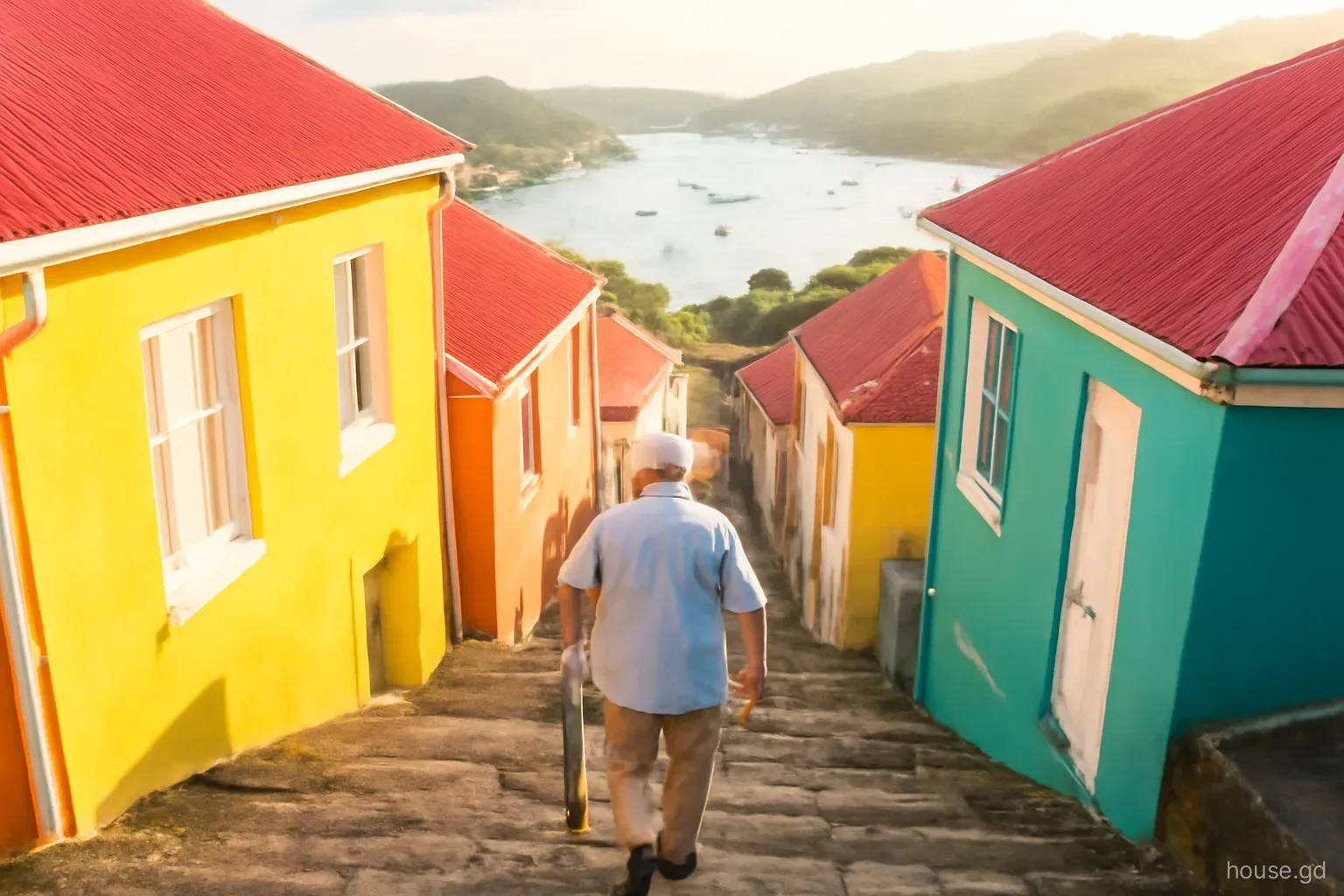
Most foreigners who move to Grenada never consider living in the capital. They visit St George's for the market, the bank or a government office and drive back to the south coast. Yet the town and the hills that ring its harbour are home to thousands of Grenadians, and for the right person they offer something the beach areas cannot: a real town, walkable streets with history, and some of the best views on the island.
St George's is built on steep volcanic hills around the horseshoe of the Carenage and the lagoon. Neighbourhoods are defined by ridges and valleys as much as by streets. This guide introduces the main residential areas in and around town, the types of homes you find, and the practical realities of parking, noise, steps and storms.
How the town is laid out
The old core of St George's sits on a ridge between the Carenage, the inner harbour, and the open bay on the western side, where the cruise terminal and the Esplanade are. The Sendall Tunnel runs under the ridge, linking the two sides. Fort George crowns the headland, and the Anglican, Catholic and Presbyterian churches mark the skyline behind it.
Around this core the town spreads into neighbourhoods on every slope: Tanteen and the area near the National Stadium and Botanical Gardens to the south-east, Belmont and the lagoon side towards Grand Anse, Tempe and Springs inland to the east, Richmond Hill with its historic fort above the town, and Mt Moritz and Grand Mal along the coast road to the north.
The main roads in and out are few and they converge, which is why traffic in the capital at peak hours is heavy despite its small size. Living close enough to walk to work in town avoids that daily bottleneck entirely.
The neighbourhoods at a glance
The town centre and Carenage. A small number of apartments above shops and offices, plus older townhouses. Lively by day, quieter at night except around bars and on festival days. Ideal for those who want to walk everywhere and do not mind street noise.
Tanteen. Flat by local standards, near the playing field, the Ministerial Complex and the Botanical Gardens. Convenient for government workers and families; mixes older homes with newer buildings.
Belmont and the lagoon side. Between town and Grand Anse, with access to both. Residential streets, some commercial activity and views over the lagoon and the yacht marina.
Tempe and Springs. Established Grenadian residential areas inland, with family homes, churches and schools. Less traffic noise, steeper streets, closer community ties.
Richmond Hill. High above town around the historic forts, with commanding views. Roads are steep and winding; the area combines government facilities, older homes and some newer houses.
Mt Moritz and Grand Mal. North along the west coast road, on hillsides above the sea. Quieter and more residential, with sunsets over the Caribbean and a short drive into town.
Homes in the capital: old stone, tin roofs and concrete
St George's is one of the most architecturally coherent towns in the Caribbean, with Georgian-era buildings of brick and stone, red fish-scale tiles on some roofs and painted tin on many more. Several large fires in the eighteenth century led to rules favouring brick and stone, which is why the old core looks as it does. Living in one of these buildings is rare but possible.
Older houses can be beautiful and badly in need of work at the same time. Hurricane Ivan in 2004 damaged a large share of the town's roofs, and while much has been repaired, some historic buildings remain shells. Restoring a heritage property involves structural engineering, careful sourcing of materials and patience with approvals, and may involve heritage considerations for listed sites.
Away from the historic core, most homes are modern concrete houses or apartments built in stages, similar to those across the rest of the island. Rentals for professionals working in town are often self-contained apartments in family houses, which come with a landlord nearby and modest rents compared with the south coast.
Living with steps, slopes and parking
The topography that gives St George's its beauty also makes daily life physically demanding. Practical points to weigh:
- Many houses are reached by steps rather than a road to the door. Carrying shopping, furniture or a child's pushchair up flights of concrete steps is part of life in parts of town.
- Parking is scarce in the centre and on narrow residential streets. Ask whether a house has its own parking space, and how reliably you can get in and out of it when the street is busy.
- Some roads are effectively one-way by convention because two cars cannot pass. Learn the local rules of who reverses.
- Steep streets become slippery in heavy rain, and drains can overflow. Look at how water runs past a property during a downpour.
- Mobility issues matter more here than almost anywhere else on the island. Older buyers should think about whether they will manage the steps in ten or fifteen years.
- On the plus side, many errands, government offices, banks, the market and doctors are within walking distance for those who live close to the centre.
Noise, festivals and the life of the town
Town is lively. Minibuses gather at the bus terminal near the Esplanade and blare music as they leave. Saturday is market day, when Market Square fills with vendors and buyers from early morning. Cruise ship days bring crowds along the Carenage and the waterfront. Church bells, schoolchildren and street vendors are all part of the soundscape.
Carnival, known as Spicemas, peaks in August with J'ouvert in the early hours and parades through town and along the routes towards the National Stadium. Living close to the route means celebration on your doorstep for several days. Some residents love it; others leave town for the week.
At night, the centre quietens considerably compared with the south-coast entertainment strip, though bars on the Carenage and some neighbourhood spots carry on late at weekends. Hillside neighbourhoods above town are generally quiet, with the sounds of tree frogs, dogs and the occasional sound system.
Who chooses the capital, and why
The people who thrive in St George's tend to share a few traits. Many work in town, in government ministries, banks, law offices or the courts, and value walking to the office instead of sitting in traffic from the south. Others are drawn by the architecture and the sense of living in a real place with its own rhythm rather than a resort area.
Some foreign residents choose a hillside house above the harbour for the view alone: cruise ships, schooners and fishing boats moving across the bay, the forts lit at night and the sunset over the Caribbean Sea. Those homes are among the most memorable on the island, and they rarely stay on the market long.
The town suits people less well if they need level access, plan to entertain guests who expect a pool and a beach, or want to let the property to holidaymakers, who overwhelmingly look for the south coast.
What to check before choosing a home in town
Structural condition. Older stone and brick buildings need a structural engineer's inspection, and timber elements should be checked for termites and rot.
Roof and storm exposure. Exposed ridges catch strong winds. Look closely at the roof fixings, gutters and any evidence of repairs after past storms.
Access for emergencies. Consider how an ambulance or fire vehicle would reach the house, especially if it is up steps or on a narrow lane.
Water and drainage. Water pressure varies across the hills. Check for storage tanks and a pump, and how the property drains in heavy rain.
Heritage and planning constraints. Altering a historic building or building in a sensitive area may require additional approvals. Ask your attorney and architect before committing to renovation plans.
Frequently asked questions
Is it a good idea to live in St George's town?
For people who want to walk to work, enjoy historic surroundings and be part of daily Grenadian life, yes. Those who want a quiet beach lifestyle, easy parking and level ground are usually happier on the south coast.
Are rents in St George's cheaper than on the south coast?
Generally yes, especially for apartments aimed at local professionals. Houses with views and parking command higher rents, and the supply of rentals marketed to foreigners is smaller, so local contacts and word of mouth are useful.
Which part of St George's is quietest?
Residential hillside areas such as Tempe, Springs, the upper parts of Belmont and the coastal hills towards Mt Moritz are typically quieter than the centre and the Carenage, though every neighbourhood has its dogs, roosters and occasional parties.
Can you buy a historic house in St George's?
Historic properties do come up for sale, sometimes in need of extensive restoration. Have a structural engineer inspect it, budget generously, and check with your attorney and the planning authority whether heritage constraints apply.
How bad is traffic in St George's?
The town is small but its roads are narrow and converge on a few routes, so morning and late-afternoon traffic can be slow, particularly between the capital and Grand Anse. Living within walking distance of your work avoids most of it.