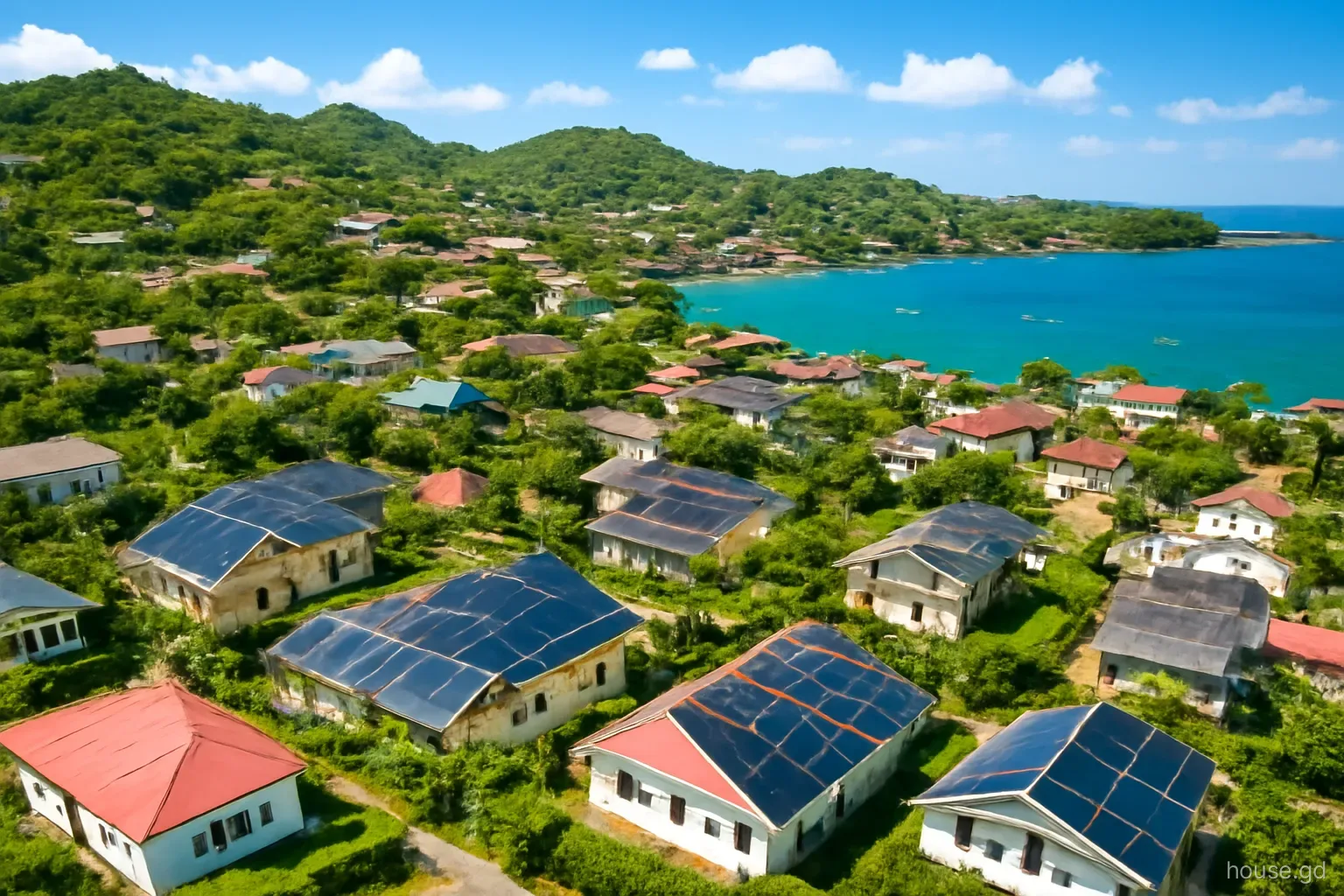
Electricity in Grenada is mostly made by burning imported diesel, and every household feels that in the monthly GRENLEC bill. A three-bedroom house running two or three air-conditioners can easily use several hundred kilowatt-hours a month, and at the rates Grenadians pay, that becomes one of the largest fixed costs of living here. Sunshine, meanwhile, arrives free and in reliable quantity almost every day of the year.
So the question is rarely whether solar works in Grenada; it works very well. The real question is whether it pays back on your particular roof, with your particular usage and under the interconnection rules that apply when you sign up. That depends on four numbers: what you pay per kilowatt-hour, how much of the solar output you use yourself, what you are credited for the rest, and what the system costs installed. This article walks through each one so you can test a quote rather than take it on trust.
What your GRENLEC bill is really charging you
Before comparing any solar quote, pull twelve months of bills. The residential bill is built from an energy charge per kilowatt-hour, a fuel charge that moves with world oil prices, a fixed customer charge and VAT where it applies. The fuel component is the reason bills jump without any change in your habits: when oil rises, it flows through within weeks. Add the parts together and divide by the kilowatt-hours used to find your true average cost per unit. For many homes this has sat somewhere around EC$0.80 to EC$1.10 per kWh in recent years, but it changes, so use your own figure.
Next, look at the pattern of use. Twelve months matter because a house with air-conditioning uses noticeably more from about April to October, when nights stay warm and humid, than in the cooler, breezier weeks around January. If your usage is 250 kWh in February and 550 kWh in September, size and judge the system against the annual total rather than one month.
Finally, note how much of your use happens in daylight. A home office, a pool pump on a timer, a chest freezer and air-conditioning in a room that is occupied during the day all line up neatly with solar production. A household out at work all day and running three bedroom units at night does not.
How much a solar array produces here
The sun resource is strong and steady. At roughly 12 degrees north, Grenada averages something in the region of five to six peak sun hours a day across the year, with little seasonal swing compared with northern countries. Cloudy wet-season afternoons cut output, but rarely for long.
A useful rule of thumb. Each kilowatt of panels (1 kWp) on a well-oriented, unshaded roof tends to produce around 4 to 4.5 kWh a day after real-world losses from heat, dust, wiring and the inverter. That is roughly 120 to 135 kWh a month, or 1,400 to 1,600 kWh a year.
Heat reduces efficiency. Panels lose output as they get hot, and a dark roof in Grenville or Grand Anse at noon is very hot. Mounting with an air gap underneath helps; installers who quote laboratory figures without a temperature allowance are overselling.
Shade and orientation still matter. Breadfruit and mango trees, a neighbour's upper floor or a hill to the west can shave hours off production. At this latitude a low tilt facing roughly south works well, but east- and west-facing roof planes are perfectly usable at a modest loss.
Salt and dust. Homes close to the sea on the south coast collect a salty film on the glass. A rinse with fresh water every month or two in the dry season is often enough to recover lost output.
Self-consumption versus export: where the money is made
Every kilowatt-hour your panels produce goes one of two ways. Either you use it at the moment it is made, and it displaces power you would otherwise buy at your full average rate, or it flows out to the grid. Exported power is credited under whatever interconnection arrangement GRENLEC and the regulator, the Public Utilities Regulatory Commission (PURC), have in place when you connect. Historically, exports have been credited at a lower rate than the price you pay for imports, broadly reflecting the fuel the utility avoids burning.
That gap is why self-consumption drives payback. A system producing 600 kWh a month where you use 450 kWh directly and export 150 kWh earns far more than the same system where you use 200 kWh and export 400 kWh. It also explains why oversizing an array beyond what the house can absorb in daylight rarely makes financial sense unless you add batteries.
Interconnection programmes have also had limits on total capacity and approval queues at times. Before you commit to a quote, ask the installer to confirm in writing which scheme you would join, the current export credit and whether there is space in it. Better still, ask GRENLEC or the PURC directly; rules change and installers are not always up to date.
A worked payback example
The figures below are illustrative only, to show the method. Replace every number with your own bill data and a real quote.
- Usage: the household uses 5,400 kWh a year (450 kWh a month) and pays an average of EC$0.90 per kWh, about EC$4,860 a year.
- System: a 4 kWp grid-tied array is quoted. At 4.2 kWh per kWp per day, it produces about 6,100 kWh a year.
- Split: with someone home during the day and the pool pump moved to midday, the household uses 55 per cent of the output directly, about 3,350 kWh, saving EC$3,015 at the full rate.
- Export: the remaining 2,750 kWh are exported. If credited at, say, EC$0.40 per kWh, that is worth about EC$1,100.
- Annual benefit: about EC$4,100. Allow some panel degradation (often around half a per cent a year) and an inverter replacement somewhere around year 10 to 15.
- Cost: if the installed price is EC$27,000 to EC$40,000 (roughly US$10,000 to US$15,000 at the fixed EC$2.70 peg), simple payback lands between about six and a half and ten years. Higher self-consumption or higher fuel prices shorten it; lower export credits lengthen it.
Mistakes that wreck the numbers
Most disappointing solar purchases in the islands come down to a handful of avoidable errors.
- Sizing from one bad month. A September bill with guests and every unit running overstates your needs; size from the annual total.
- Ignoring the export rate. A quote that values every kilowatt-hour at your full import price inflates savings, sometimes by a third or more.
- Skipping the roof check. Panels last 25 years. Fitting them on a galvanise roof that needs replacing in five means paying twice for removal and refitting.
- Weak fixings. In a hurricane zone, rails must be fixed into rafters or purlins with corrosion-resistant hardware, not just screwed into sheeting.
- Forgetting insurance. Tell your home insurer about the array; an undeclared system may not be covered after a storm.
- Buying batteries for the wrong reason. Batteries add resilience during outages, but on a pure money basis they usually lengthen payback rather than shorten it.
When solar is a clear yes, and when to wait
Solar tends to make the strongest sense for owner-occupiers who plan to stay at least eight to ten years, have a sound, unshaded roof, and use a good share of their electricity during the day. Retirees at home, people working remotely and small guesthouses with daytime laundry and pool loads fall neatly into this group.
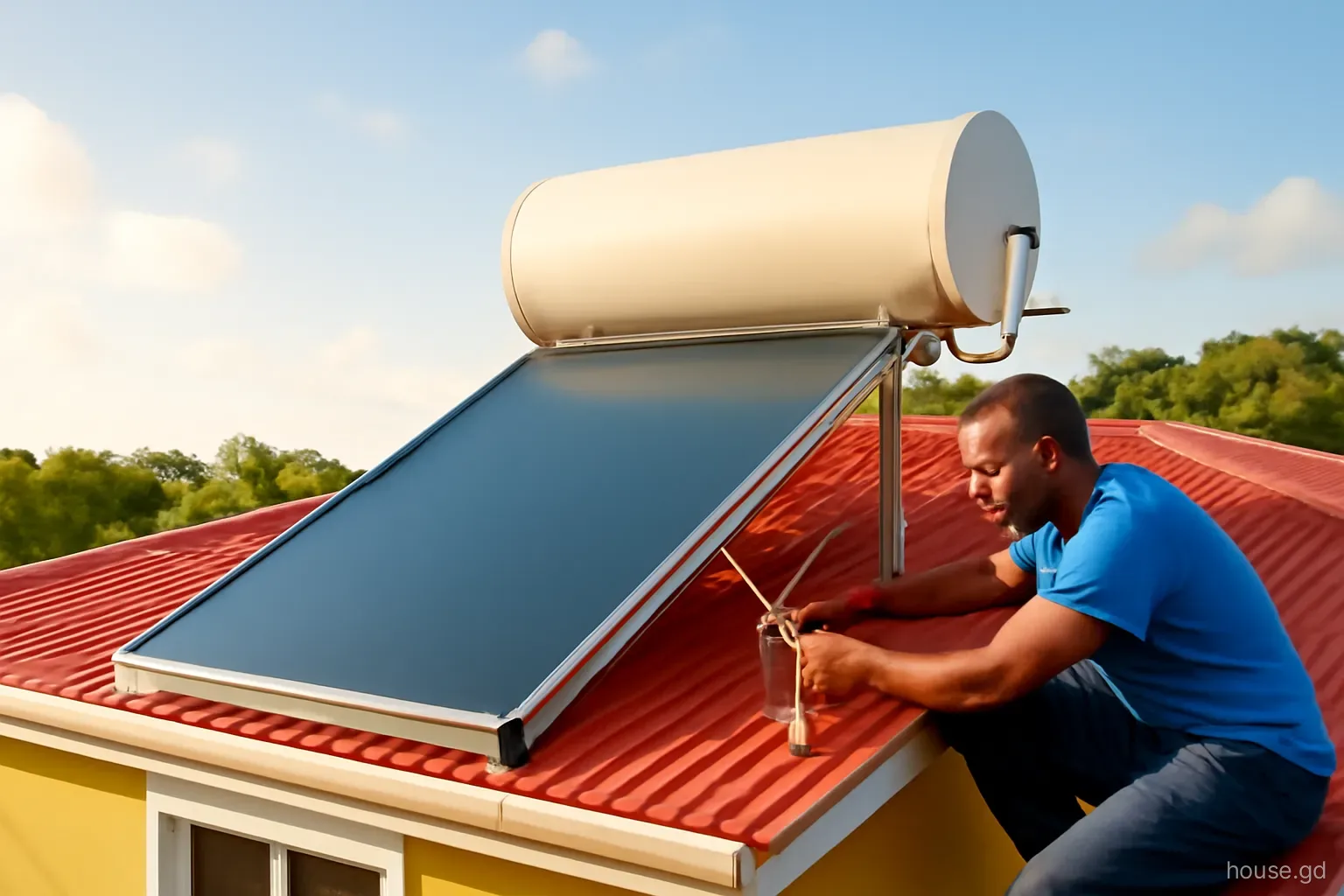
It is worth waiting if the roof is due for replacement, if you might sell within a few years and the buyer market in your area does not yet value solar, or if the interconnection scheme is full and no export credit is available. In those cases, spending first on efficiency, such as inverter air-conditioners, a newer refrigerator and a solar water heater, often returns more per dollar and makes any future array smaller and cheaper.
Whatever you decide, get two or three written quotes that state the panel and inverter models, expected annual production, the export assumption used and the warranty terms, and confirm interconnection rules with the utility and regulator before signing.
Frequently asked questions
How many solar panels does a typical Grenada house need?
A home using 400 to 500 kWh a month would usually look at roughly 3.5 to 5 kWp, which is about eight to twelve modern panels. The right number depends on daytime usage, roof space, shading and the export credit available, so base it on twelve months of bills.
Does solar work during the rainy season in Grenada?
Yes. Output falls on heavily overcast days, but Grenada rarely has long sunless spells, and the wet season still brings strong sunshine between showers. Annual production estimates already allow for cloudy periods, so monthly totals vary less than people expect.
Will a grid-tied system keep my lights on during a power cut?
No. A standard grid-tied inverter shuts down when the grid fails so it cannot send power down lines being repaired. To keep running during outages you need a hybrid inverter with batteries or a separate backup arrangement.
Do you need permission to install solar panels in Grenada?
Connecting a system to the grid requires approval from GRENLEC under rules overseen by the PURC, and the installation should be done and certified by a licensed electrician. Major roof or structural work may also involve the planning authority. Confirm the current steps before work begins.
How long do solar panels last in salt air?
Good panels carry 25-year performance warranties and generally last that long, though frames and fixings near the sea need corrosion-resistant materials. Inverters have shorter lives, often 10 to 15 years, and should be mounted in a shaded, ventilated spot away from direct salt spray.
Does solar add value when selling a house in Grenada?
It can, especially for buyers from abroad who look closely at running costs, but the market does not yet price it consistently. Keep paperwork, warranties and production records, as documented low bills are the most persuasive evidence for a buyer.